
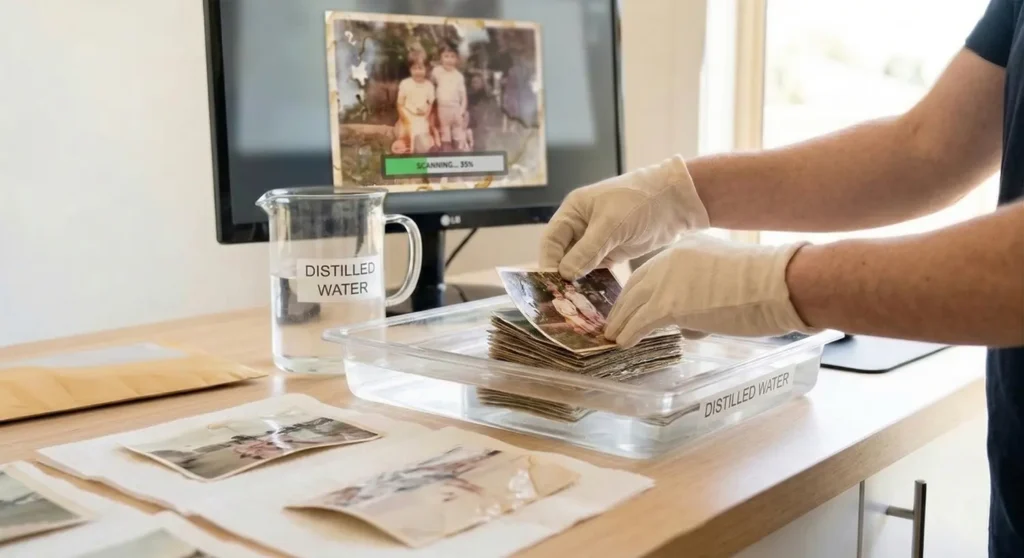
💧 Brighter Days Ahead: How to Rescue Water‑Damaged Photos Using Distilled Water
Water damage from floods, leaks, storms, or even a spilled drink can be heartbreaking — especially when cherished family photos end up stuck together in a soggy block. But before you panic, take a breath. Most water‑damaged photos can be saved if handled correctly.
At Photo Restoration Rescue, we’ve helped families across Australia recover irreplaceable memories after water disasters. This guide walks you through the safest first‑aid method for separating stuck photos using distilled water — and just as importantly, when not to use it.
🛑 The Golden Rule: Stop — Don’t Peel Them Apart
When photos get wet, the gelatin emulsion (the layer that holds the image) softens and becomes sticky. As they dry, this emulsion bonds photos together like glue.
Trying to pull them apart dry will:
Tear off the image layer
Remove faces and details
Leave blank patches
Cause irreversible damage
If your photos are stuck together, do not peel, pry, or pull. The safest solution is actually more water — but only the right kind.

💧 Why Distilled Water Is the Safest Way to Separate Stuck Photos
Tap water contains minerals, chlorine, and impurities that can:
Leave stains
Cause chemical reactions
Create hard‑water spots
Damage the emulsion further
Distilled water is pure H₂O, making it the safest way to rehydrate the emulsion and gently release stuck layers.

🌟 When Distilled Water Can Save Your Water‑Damaged Photos
Distilled water is ideal when:
✔️ Photos Are Modern Prints (1950s–Present)
Glossy or matte colour and B&W prints respond well to controlled rehydration.
✔️ Photos Are Still Damp or Soft
Not dried into a hard “brick.”
✔️ Photos Are Stuck Together in a Stack
A gentle soak can soften the emulsion enough to separate them.
✔️ A Photo Is Stuck to Glass
Distilled water can sometimes release the bond safely.
✔️ Photos Need Rinsing After Mud or Dirty Water
A pure water bath removes debris without adding new contaminants.
✔️ The Emulsion Is Intact
No bubbling, melting, or sliding.
If your photos meet these criteria, distilled water is your best rescue tool.

🧼 How to Separate Stuck Photos Using Distilled Water
(Safe, Conservation‑Friendly Method)
🧰 What You’ll Need
Room‑temperature distilled water
Two shallow trays
Cotton gloves
Clean absorbent paper (paper towels or blotting paper)
A thin silicone spatula or microspatula
A fan for gentle airflow
Patience — this process cannot be rushed
Step 1: Act Fast — Keep Photos Moist
If the photos are still wet:
Place them in a sealed bag with a damp (not dripping) paper towel
Prevent them from drying stuck together
Never pry apart semi‑dry photos
Drying while fused often makes separation impossible.
Step 2: Prepare the Distilled Water Bath
Fill a clean tray with room‑temperature distilled water. Avoid warm or hot water — heat melts the emulsion.
Step 3: Soak the Stuck Photos (15–30 Minutes)
Place the stack image‑side up into the water.
Let them float or submerge naturally. Do not push them down.
Check progress every few minutes.
Step 4: Gentle Separation
Once the emulsion softens:
Work underwater
Slide your fingers or a spatula between layers
Ease them apart from the edges
Never pull vertically
If they resist, soak longer
This can take anywhere from 30 minutes to a couple of hours.
Step 5: Rinse (Optional)
If the photos were exposed to mud or debris:
Transfer them to a second tray of fresh distilled water
Gently rock them back and forth
Never rub the surface
Step 6: Drying
Lay photos image‑side up on clean absorbent paper for a moment only to soak up excess water then lay it on baking paper so it does not stick to surface after drying.
Avoid:
Sunlight
Heat
Hairdryers
Allow gentle airflow from a fan. Curling is normal and can be corrected later.
❗ When NOT to Use Distilled Water
Distilled water is powerful — but not always safe. Avoid soaking if:
❌ The Photos Are Antique or Historical
Daguerreotypes, tintypes, ambrotypes, albumen prints, cartes de visite — these can dissolve or distort.
❌ The Photos Are Home Inkjet Prints
Inkjet inks are water‑soluble and will wash away instantly.
❌ The Emulsion Is Already Bubbling or Sliding
Water will accelerate the loss.
❌ The Photos Are Dry and Fused Into a Hard Block
Soaking can cause severe distortion and emulsion loss.
❌ Mold Is Present
Water spreads spores and worsens staining.
❌ The Photos Are Stuck to Glass and Visibly Bonded
This requires professional handling.
❌ The Photos Are Extremely Valuable or One‑of‑a‑Kind
Professional conservation is essential.

🛑 Over‑Soaking Risks
Limit soaking time. Hours of soaking can cause:
Dye bleeding
Paper swelling
Emulsion distortion
Colour shifts
If separation isn’t happening, stop and seek help.
🧡 Feeling Overwhelmed? You’re Not Alone
Rescuing water‑damaged photos can be emotional and stressful. If you notice:
Emulsion sliding off
Colour bleeding
Severe resistance
Mold activation
Or you’re simply too anxious to continue
…it’s time to hand the job to a professional.
🛠️ Professional Water‑Damaged Photo Restoration (Melbourne & Australia‑Wide)
At Photo Restoration Rescue, we specialise in:
🔹 Professional separation using conservation chemistry
🔹 Mold remediation and stabilisation
🔹 High‑resolution scanning of fragile originals
🔹 Digital reconstruction of damaged or missing areas
🔹 Colour correction and detail recovery
🔹 Archival‑grade prints and digital backups
Even if the physical photo is destroyed, we can often digitally rebuild the image from fragments, stains, or faded remnants.
📞 Need Help With Water‑Damaged Photos?
f your photos are stuck together, moldy, muddy, or too precious to risk, reach out for a free quote and proof.
📍 Based in Melbourne — serving all of Australia
📦 Mail‑in and drop‑off options available
🖥️ Upload scans for fast digital assessment
Your memories matter. Let’s rescue them together.
Photo restoration made simple.
Allow our experts to restore your damaged photos with precision and care - satisfaction guaranteed! Proofs and tweaks included — no surprises, just satisfaction.
01. Get Your Quote
Upload a photo for a free price estimate.
02. Review Proofs
See our work before you finalise your order.
03. Digital Delivery
Download your high‑res restored image.
Frequently Asked Questions About Water-Damaged Photos
Can water-damaged photos be saved?
Yes — many water-damaged photos can be saved if handled quickly and correctly. Keeping them moist and avoiding peeling is essential until you can safely separate them.
Why do photos stick together after getting wet?
The gelatin emulsion softens when wet and acts like glue. As it dries, it bonds photos together, making them extremely fragile.
Is distilled water safe for separating stuck photos?
Yes — distilled water is the safest option for modern photographic prints (1950s–present) that are still damp and not moldy.
When should I NOT use distilled water?
Avoid distilled water for antique photos, inkjet prints, moldy photos, dry fused stacks, or images stuck to glass with visible emulsion bonding.
Can I use tap water instead of distilled water?
Tap water can be used for an initial rehydration soak if distilled water isn’t available, but distilled water should always be used for the final rinse.
How long should I soak stuck photos?
Most photos separate within 15–30 minutes, but some may take up to a couple of hours. Never force them apart.
What if the emulsion starts sliding off?
Stop immediately. This means the photo is too fragile for DIY methods and needs professional conservation.
Can you restore photos that were damaged in a flood?
Yes — even if the physical print is badly damaged, we can often digitally rebuild the image from fragments, stains, or faded areas.
Do you accept mail-in photo restoration from outside Melbourne?
Yes — we serve clients Australia-wide with secure mail-in and digital upload options.